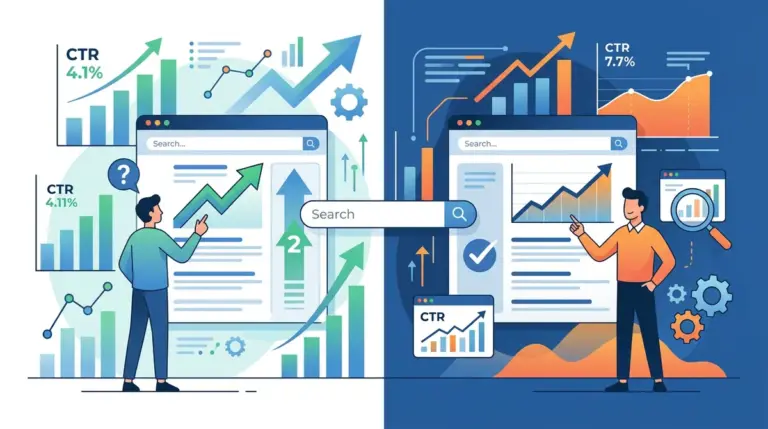
B2B search results are a graveyard of "Ultimate Guides" and "Complete Manuals" that fail to address the specific pain points of a procurement officer or a VP of Engineering. In a landscape where a single click can represent a six-figure contract, generic title tags are a revenue leak. Improving B2B click-through rates (CTR) requires moving beyond keyword density and toward psychological triggers that signal professional relevance, risk mitigation, and immediate utility.
The challenge in B2B SEO is that the searcher is rarely browsing for fun; they are performing a "job to be done." If your title tag doesn't promise a solution to that specific task, they will skip it for a competitor who does. To capture high-intent B2B traffic, you must align your metadata with the specific stage of the buyer's journey while maintaining technical rigor.
Quantifying the Value Proposition in 60 Characters
B2B buyers are driven by efficiency and ROI. Vague titles like "Best CRM Software" are too broad to attract a qualified lead who is actually ready to buy. Instead, use specific data points or outcomes to differentiate your link from the sea of blue text.
Best for: Mid-to-bottom funnel pages where the user is comparing solutions or looking for proof of performance.
When you include a percentage, a dollar amount, or a specific timeframe, you provide a concrete anchor for the user. For example, "How to Reduce Churn by 15% in 90 Days" is significantly more clickable than "Strategies for Reducing Customer Churn." The former promises a measurable result, which appeals to the analytical nature of a B2B decision-maker. By incorporating these elements, you can write SEO titles people want to click and significantly boost engagement.
Shifting from Features to Business Outcomes
Most B2B titles focus on what the product is, rather than what it does for the organization. To fix this, replace nouns with high-impact verbs that imply progress. Instead of "Cloud Security Features," try "Secure Your Remote Workforce Against Zero-Day Exploits." This shifts the focus from a static list to an active solution.
Leveraging Authority Triggers for High-Ticket Services
In B2B, trust is the primary currency. A user searching for "Enterprise SEO Services" is looking for an agency that won't blow their budget or ruin their site's indexing. You can bake authority directly into your title tags to increase the perceived safety of clicking your link.
- Industry-Specific Labels: Use terms like "For Manufacturers," "SaaS-Focused," or "HIPAA-Compliant" to immediately qualify the reader.
- The "Expert" Pivot: Incorporate phrases like "Peer-Reviewed," "Engineer-Led," or "Data-Backed" to distance your content from AI-generated fluff.
- Current Year and Versioning: B2B sectors move fast. Including "[2024 Update]" or "Version 4.0" signals that the information is current and hasn't been sitting in a CMS for three years.
Pro Tip: Avoid using "The Best" in B2B titles. It is a subjective, overused claim that triggers skepticism in professional buyers. Use "Top-Rated," "Industry-Standard," or "Most-Integrated" instead, as these imply external validation or technical compatibility.
Technical Precision: Avoiding the Ellipsis of Death
Google typically truncates title tags after 580 to 600 pixels (roughly 50-60 characters). In B2B, where product names and technical terms are often long, you risk losing your most important value proposition to the ellipsis (...). If your brand name is long, move it to the end of the tag or remove it entirely for deep-funnel content where the solution is more important than the vendor name.
Best for: Mobile searchers and users scanning high-density SERPs.
Front-load your most important keyword and your primary differentiator. If you are targeting "Inventory Management Software for Small Warehouses," do not start the title with "The Most Comprehensive Guide to Selecting the Right..." by the time the user gets to "Small Warehouses," the text is cut off. Start with the specific audience or the core solution.
The Psychology of Risk Mitigation in B2B Titles
B2B buyers are often more afraid of making a mistake than they are excited about making a gain. A bad software choice can cost a manager their job. You can increase CTR by addressing these fears directly in your metadata.
Using Negative Constraints to Drive Clicks
While positive reinforcement works in B2C, negative framing can be highly effective in professional contexts. Titles like "5 Mistakes to Avoid in Your SOC2 Audit" or "Why Your Current ERP is Costing You $5k Monthly" tap into loss aversion. These titles demand a click because the user needs to ensure they aren't currently failing at a critical task.
A/B Testing B2B Titles Without High Traffic
Many B2B pages suffer from low search volume, making traditional A/B testing difficult. However, you can use PPC data to inform your SEO titles. Run a small-budget Google Ads campaign with two different headlines for the same landing page. The headline with the higher CTR in Ads is almost always the winner for your organic title tag.
Another method is to analyze your Google Search Console (GSC) data. Look for pages with high impressions but low CTR. If a page is ranking in position 3 but has a CTR below 5%, your title is likely the culprit. Test a "Bracketed Clarifier" like [Case Study] or [Checklist] at the end of the title; these often see a 10-15% lift in clicks because they define the content format before the user even lands on the page.
Execute a CTR Audit for B2B Content
To move the needle on your organic traffic without building a single new backlink, follow this workflow for your top 20 revenue-generating pages. First, identify the primary "job" the user is trying to accomplish on that page. Second, rewrite the title to include a concrete outcome or a risk-mitigation trigger. Third, ensure the most important information appears within the first 40 characters to prevent mobile truncation. Finally, monitor the "Average CTR" metric in GSC for 30 days to validate the change. Small, iterative adjustments to your B2B titles often yield higher ROI than wholesale content rewrites.
Frequently Asked Questions
How long should a B2B SEO title be?
Aim for 50 to 60 characters. While Google can index longer titles, anything beyond 600 pixels will be cut off in the search results, potentially hiding your call to action or key differentiators. If your titles aren't performing as expected, consider rewriting underperforming SEO titles to capture more attention.
Should I include my brand name in every B2B title?
Not necessarily. For high-intent or "bottom of funnel" pages, the solution is more important than the brand. If your brand is not a household name, use that space for a benefit or a technical specification instead.
Do brackets and parentheses really improve CTR?
Yes. Brackets like [Template], [Report], or [Video] provide immediate context about the page's utility. In a B2B context, this helps the user understand exactly what "tool" they are clicking on, which reduces the perceived effort of the search.
Is it better to use a question or a statement in a B2B title?
Statements that promise a solution generally perform better for transactional keywords. Questions work well for top-of-funnel, informational queries where the user is in the "problem identification" phase of their journey.