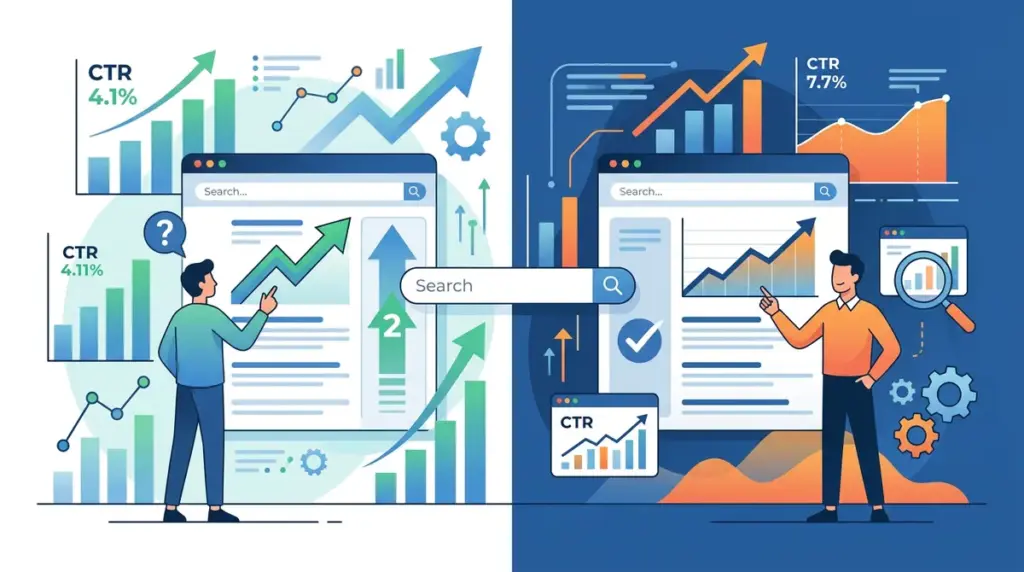
The choice between a question and a statement in your title tag is the difference between inviting a conversation and issuing a command. For SEO professionals and media buyers, this isn't an aesthetic preference; it is a tactical decision that dictates the quality of the traffic entering the funnel. While questions leverage the "curiosity gap" to drive clicks from users seeking exploration, statements project authority and satisfy the immediate needs of high-intent searchers. Choosing the wrong format results in high bounce rates or, worse, invisible listings that fail to capture the user's eye in a crowded SERP.
The Cognitive Trigger of Question-Based Titles
Question titles function by creating an open loop in the reader's mind. When a user sees a question that mirrors their internal dialogue—such as "Is Organic Reach Dead in 2024?"—their brain naturally seeks closure. This cognitive reflex is a primary driver of click-through rates for informational and top-of-funnel content. Data from various click-through studies suggests that question-based titles can outperform statements by 14% to 33% in environments where the user is in "discovery mode," such as social feeds or broad informational searches.
Best for: Problem-aware audiences, long-form guides, and contrarian opinion pieces where the goal is to challenge a status quo.
However, the effectiveness of a question depends heavily on the interrogative used. "How" and "Why" questions typically perform better for SEO because they promise a process or a rationale. "Should" questions create a sense of urgency or doubt, which is highly effective for product comparisons. Conversely, "Yes/No" questions are risky; if the user believes they already know the answer, they have no incentive to click. This is known as Betteridge's Law of Headlines: any headline that ends in a question mark can be answered by the word no.
The Authority and Precision of Statement Titles
Statement titles are declarative. They do not ask the user to think; they tell the user what they will find. For high-intent, transactional, or "how-to" keywords, statements almost always outperform questions. A user searching for "Best CRM for real estate" is not looking for a question like "Which CRM is best for real estate?" They want a definitive list. A statement title like "10 Best Real Estate CRMs for 2024 (Ranked & Reviewed)" provides immediate reassurance that the search intent will be met. This focus on meeting user intent is key to making statement titles more clickable.
Best for: Transactional keywords, listicles, product pages, and technical documentation where the user values speed and certainty over curiosity.
Statements are also more effective at capturing "feature-driven" clicks. By including specific data points—such as "74% Increase in ROI"—within a statement, you provide a concrete anchor for the user’s expectations. This reduces the cognitive load required to process the search result, making the click a low-friction decision.
Warning: Avoid "Fake Questions" in your titles. These are statements disguised as questions, such as "Do You Want More Traffic?" Users perceive these as low-effort clickbait. If the answer is an obvious "yes," the question adds zero value and can actually decrease trust before the first click occurs.
Matching Title Format to Search Intent
To maximize CTR, the title format must align with the user's position in the buying journey. Misalignment here is a common cause of high impressions but low clicks.
- Informational Intent (Top of Funnel): Questions excel here. Users are identifying problems and looking for frameworks. Example: "Why is my bounce rate so high?"
- Commercial Investigation (Middle of Funnel): A mix of both works, but comparative statements often win. Example: "SaaS Tool A vs. SaaS Tool B: The Full Comparison."
- Transactional Intent (Bottom of Funnel): Statements are mandatory. Users are ready to act and want the most direct path to the solution. Example: "Buy Organic Coffee Beans - Free Shipping."
In the context of SERP features, questions are particularly powerful for winning "People Also Ask" (PAA) boxes and Featured Snippets. Google’s algorithm is designed to match direct questions in search queries with direct questions in H1s and Title tags. If your page aims to be the definitive answer to a specific query, phrasing your title as that exact question increases the likelihood of being pulled into the Zero-Position snippet.
The Impact of Punctuation and Syntax on CTR
It is not just the words, but the punctuation that signals the intent. Question marks act as visual disruptors in a sea of periods and pipes. However, overusing them can make a brand appear desperate or "spammy." Statement titles benefit from brackets and parentheses, which act as "content modifiers." For example, "SEO Strategy 2024 [Template Included]" uses a statement to establish authority and a modifier to add value. This combination often sees a higher CTR than a standalone question because it promises both the "what" and the "how."
Sentence length also plays a role. Short, punchy statements (5-7 words) convey confidence. Longer, more nuanced questions (10-12 words) convey depth. When testing, monitor the "Position-to-CTR" ratio. If a statement title ranks at position 3 but has the CTR of a position 5 result, it is likely too generic and needs the "hook" of a question or a more specific data point.
A/B Testing Your Title Strategy
Never assume one format will work for all categories of your site. A robust testing framework is required to determine which pages benefit from a shift in tone. Use the following steps to refine your titles:
1. Segment your pages by intent: Do not test a question title on a product page and a statement title on a blog post and compare them. Compare like-with-like.
2. Isolate the variable: Change only the title format. Keep the URL, meta description, and on-page content identical during the test period to ensure the CTR change is attributable to the title.
3. Analyze the "Long Click": CTR is a vanity metric if it leads to an immediate bounce. Use a statement if the question is driving clicks but the time-on-page is dropping; this indicates the title is over-promising and under-delivering.
Strategic Implementation for Maximum Yield
The most effective SEO strategy often involves a hybrid approach. Use question titles for your blog and resource center to capture wide-reaching informational queries and build brand awareness through curiosity. Reserve statement titles for your service pages, product categories, and landing pages where the user is looking for a specific outcome. By treating your title tags as dynamic conversion assets rather than static labels, you can manipulate the SERP to favor your brand's specific goals. Monitor your Search Console data weekly; a 1% lift in CTR for a high-volume keyword can result in thousands of dollars of "free" traffic that a statement-only or question-only strategy would have left on the table.
Common Title Strategy Questions
Do question titles work for B2B audiences?
Yes, but they must be sophisticated. Avoid "What is SEO?" and instead use "Can your current SEO strategy survive the next core update?" B2B buyers respond to questions that highlight risk or efficiency gaps.
Will changing a statement to a question hurt my rankings?
It can if you remove core keywords. Always ensure the primary keyword remains near the front of the title, regardless of whether it is a question or a statement. The impact on rankings is usually secondary to the impact on CTR.
Should I use a question mark in every blog title?
No. If every title is a question, your site looks like a forum rather than an authority. Use questions strategically for topics where there is genuine debate or a complex problem to solve.
Which format is better for PPC ads?
Statements generally perform better in paid search because the user is often further down the funnel. However, in display or social ads, questions are superior for stopping the scroll and generating initial interest.