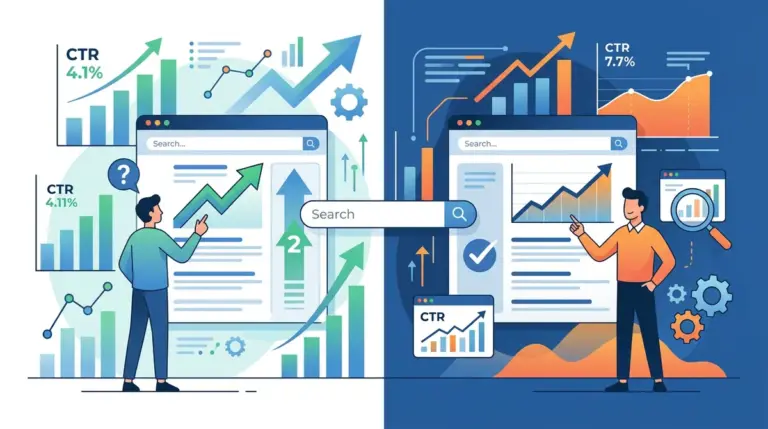
Search intent is a moving target. For high-volume commercial queries—especially those involving software, guides, or product comparisons—a title tag from eighteen months ago isn't just stale; it is a liability. Users subconsciously filter search results for temporal relevance, often bypassing the top organic result for a lower-ranked entry that promises information from the current year or month. This behavior creates a measurable gap between theoretical ranking potential and actual traffic capture.
Freshness in titles is not merely a cosmetic update. It is a signal of accuracy and maintenance. When a user sees "Best CRM Software 2023" in a 2024 search environment, the immediate assumption is that the data is obsolete. The click-through rate (CTR) decay on outdated titles is aggressive, often dropping by 30% to 50% once a calendar year turns, regardless of whether the underlying content remains technically accurate. This decay highlights the importance of writing titles people want to click, ensuring your content remains discoverable and engaging.
The Psychology of the Temporal Click
The preference for fresh titles stems from a risk-avoidance heuristic. Users want to ensure they are not making decisions based on deprecated features, expired pricing, or superseded technology. In niche markets like SEO, finance, or consumer electronics, "new" is synonymous with "correct."
Breaking Down the Newness Bias
The "Newness Bias" manifests most strongly in three specific categories of search queries:
- Comparative Analysis: "X vs Y" queries where software updates can change the winner monthly.
- Regulatory or Compliance Content: Tax laws, SEO best practices, and legal requirements where old data is dangerous.
- Price-Sensitive Lists: "Best budget laptops" or "Cheapest flights," where market volatility renders old lists useless.
Best for: Publishers running affiliate comparison sites or technical documentation hubs where user trust is tied to current-state data.
Implementing Year and Month Modifiers
The most direct way to signal freshness is the inclusion of the current year or month within the <title> tag. However, the execution determines whether this results in a sustained CTR lift or a temporary spike followed by a ranking drop. Simply changing "2023" to "2024" without reviewing the content can lead to increased bounce rates, which eventually signals to Google that the "freshness" is deceptive.
Dynamic vs. Manual Updates
For sites with thousands of pages, manual updates are a bottleneck. Many SEOs use dynamic insertion strings—variables that automatically pull the current year into the title. While efficient, this carries the risk of "Title-Content Mismatch."
Warning: If your title promises "Updated for October 2024" but the body copy references data from 2021, you will see an initial CTR surge followed by a sharp decline in average session duration. Google monitors these engagement signals; deceptive freshness can lead to a long-term suppression of your rankings.
The Google "Freshness" Algorithm (QDF)
Google employs a mechanism known as "Query Deserves Freshness" (QDF). For certain topics—breaking news, recurring events, or rapidly evolving tech—Google prioritizes pages that have been recently updated or have titles reflecting the current timeframe. By updating your titles to reflect the current period, you are essentially "applying" for the QDF boost. This is particularly effective for queries that show high SERP volatility, as Google is actively looking for a reason to rotate the top results to find the most relevant, current answer.
Quantifying the CTR Lift from Freshness Signals
To measure the impact of title freshness, you must look at the CTR delta in Search Console. A standard experiment involves taking a cohort of "stale" pages (titles older than 12 months) and updating half with current-year modifiers while leaving the other half as a control group.
Observations from high-volume commercial sites typically show:
- Immediate Lift: A 15% to 25% increase in CTR within 48 hours of re-indexing.
- Ranking Stability: If the content is also refreshed, the page often climbs 1-2 positions as a result of the increased click volume (the "CTR feedback loop").
- Impression Growth: Fresh titles often trigger appearances in "People Also Ask" or "Interesting Finds" modules that favor recent dates.
Best for: Agencies looking to provide quick-win ROI for clients with large back-catalogs of evergreen content.
Managing the Risks of Title Volatility
Every time you change a title tag, you invite Google to re-evaluate the page. If a page is already ranking in position #1 or #2 for a high-value keyword, a drastic title change—even one intended to add freshness—can cause a temporary ranking fluctuation. To mitigate this, keep the primary keyword at the beginning of the title and append the freshness modifier to the end.
For example, instead of changing "2023 Guide to SEO" to "New for 2024: The Ultimate SEO Guide," use "SEO Guide: 2024 Updated Edition." This maintains the keyword prominence while signaling the update to the user.
Executing a Systematic Freshness Audit
To maximize CTR across a domain, freshness should be treated as a recurring maintenance task rather than a one-off project. Use the following workflow to institutionalize freshness:
First, identify "High-Volume, Low-CTR" pages. Use Search Console to find pages ranking in positions 1-3 that have a CTR below the site average. These are your primary candidates for title refreshes. Second, verify the content. Ensure the page actually contains updated information to support the new title. Third, update the <title> tag and the H1 to match. Consistency between the search snippet and the landing page is critical for conversion.
Finally, use the URL Inspection tool in Google Search Console to request a crawl. This forces Google to see the new title immediately rather than waiting for a natural recrawl, which can take weeks for deeper pages. Monitor the performance for 14 days to ensure the CTR lift is sustained and that rankings haven't slipped due to keyword dilution.
Frequently Asked Questions
Does changing the year in a title tag impact SEO rankings?
Yes, but usually indirectly. While the date itself is a minor ranking signal, the resulting increase in CTR and user engagement signals to Google that the page is highly relevant, which can lead to improved rankings over time. However, if the content is not actually updated, you risk a higher bounce rate which can negatively impact performance.
How often should I update titles for freshness?
For evergreen content, an annual update (changing the year) is standard. For fast-moving industries like software or finance, quarterly or even monthly updates (e.g., "Updated for October") can provide a significant competitive advantage in crowded SERPs.
Will Google rewrite my title if I add a date?
Google often rewrites titles if it believes the title tag does not accurately reflect the page content. If you add "2024" to a title but the page's schema markup or "last modified" date says 2021, Google may strip the date from the search snippet or replace it with a date they find more accurate.
Is it better to put the date at the beginning or end of the title?
Place the date at the end of the title tag. The beginning of the title should be reserved for your primary keyword to ensure maximum relevance for Google's indexing. The end of the title is where users look for secondary modifiers like "Free," "PDF," or "2024."