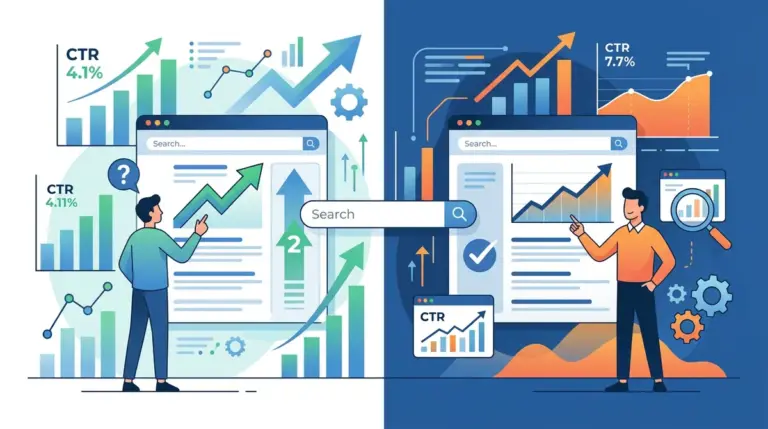
Standard SEO titles focus on relevance, ensuring the search engine understands the topic. High-performance SEO titles focus on the transaction, ensuring the user understands the reward. In a SERP environment where four ads and a featured snippet often push organic results below the fold, a keyword-optimized title is the bare minimum. To capture clicks from competitors who rank higher, you must inject a specific offer or a tangible benefit directly into the 60-character title tag.
The Structural Shift from Keywords to Value Propositions
Most SEO workflows stop at keyword density. A title like "Best Project Management Software" is descriptive but passive. It relies entirely on the user's intent to research. By contrast, a title like "Best Project Management Software - Free 14-Day Trial" or "Project Management Software: Save 10 Hours a Week" targets the user's specific pain point or desire for a low-friction entry point.
Best for: SaaS companies, e-commerce retailers, and lead-generation sites where the goal is an immediate conversion rather than just informational consumption.
When drafting these titles, the "offer" is the literal incentive (the discount, the free tool, the PDF), while the "benefit" is the outcome the user achieves (speed, savings, status). Integrating both requires a strict economy of words. You have approximately 580 pixels of width to convince a user that your link is more valuable than the nine others on the page.
Quantifying the Offer in the SERP
Numbers provide a visual anchor in a sea of text. When you include a specific offer, use digits rather than words. "20% Off" outperforms "Twenty Percent Off" because it breaks the linguistic pattern of the surrounding text. This is particularly effective for e-commerce and service-based businesses.
- Financial Incentives: Discounts, "Buy 1 Get 1," or "Under $50" markers.
- Access-Based Offers: "Free Download," "Instant Access," or "No Credit Card Required."
- Time-Bound Benefits: "Ship Today," "2-Minute Setup," or "Results in 30 Days."
- Resource-Based Offers: "Includes 5 Templates," "With Checklist," or "10-Step Guide."
For informational content, the "offer" is often the depth or utility of the content itself. Instead of "How to Write a Resume," use "How to Write a Resume: 5 Free Templates Included." The addition of the templates transforms the page from a simple article into a functional tool, significantly increasing the perceived value of the click.
Positioning Benefits for Maximum Visibility
The first 30 characters of your title tag are the most valuable real estate. While the primary keyword should usually appear early for ranking purposes, the benefit or offer should immediately follow it. If the benefit is truncated on mobile or desktop, the click-through rate (CTR) will plummet because the unique selling proposition (USP) is hidden.
Consider the "Pipe vs. Dash" strategy. Using a pipe (|) or a dash (-) creates a clean visual break that allows the eye to scan the keyword and the offer as two distinct units of information. For example: SEO Audit Tool | Get Your Free Score in 30 Seconds. This structure satisfies the search engine's need for keywords and the user's need for a quick win.
Pro Tip: Use brackets or parentheses to enclose your offer. Studies of SERP behavior consistently show that elements like [Updated for 2024] or (Free Template) draw the eye faster than plain text, acting as a visual "callout" that separates your listing from the standard blue links.
Matching the Offer to Search Intent
An offer that misaligns with intent will increase your bounce rate, which can eventually degrade your rankings. You must categorize your keywords by the user's stage in the buying cycle before assigning an offer.
Top-of-Funnel (Informational): The user wants to learn. The offer should be a resource, such as a "Cheat Sheet," "Checklist," or "Comprehensive Guide." Avoid hard-sell offers like "Buy Now" here, as they feel premature and intrusive.
Middle-of-Funnel (Comparison): The user is weighing options. The benefit should focus on differentiation. Use titles like "Tool A vs Tool B: The 2024 Comparison Guide" or "Top 10 Laptops - Expert Reviewed & Ranked." The "offer" here is the saved time of doing the research themselves.
Bottom-of-Funnel (Transactional): The user is ready to spend. This is where "Free Shipping," "Next-Day Delivery," or "Limited Time Discount" should be front and center. The title should remove any remaining friction between the search and the purchase.
Measuring the Impact with Search Console Data
Do not guess which offer works. Use Google Search Console (GSC) to run A/B tests on your title tags. Select a page with stable rankings (positions 3 through 7 are ideal for testing) and record its average CTR over a 30-day period. Change the title to include a specific benefit or offer, and monitor the CTR for the next 30 days.
Look for a "CTR Lift" that occurs without a corresponding change in average position. If your position remains at 4.2 but your CTR moves from 3.5% to 5.1%, your new offer-driven title is successfully stealing clicks from the top three results. If the CTR drops, your offer may be perceived as "spammy" or irrelevant to that specific query.
Execution Checklist for High-CTR Titles
To move from descriptive titles to high-conversion titles, apply these specific technical checks to every high-value page on your site:
- Identify the single most valuable "extra" the user gets by clicking (e.g., a discount, a faster result, a free resource).
- Ensure the primary keyword is within the first 3 characters to maintain ranking stability.
- Place the offer in brackets or after a clear separator (dash or pipe).
- Check the pixel width using a SERP simulator to ensure the offer isn't truncated on mobile devices.
- Verify that the landing page immediately delivers on the promise made in the title to prevent pogo-sticking.
Common Questions Regarding Title Tag Offers
Does adding an offer to a title tag hurt SEO rankings?
No, provided you do not remove the primary keyword. Google ranks pages based on relevance and authority, but it also monitors user signals. If an offer increases your CTR and users stay on the page, it can actually improve your rankings over time as Google sees your result as highly relevant to the query.
What if my offer changes frequently, like a weekly sale?
For frequently changing offers, use broader benefit-driven language like "Best Prices Guaranteed" or "Weekly Deals Inside" rather than specific percentages. This prevents your SERP listing from becoming inaccurate if Google takes a few days to recrawl and update your title tag.
How do I handle brand names when adding offers?
If your brand is not a household name, prioritize the offer over the brand name. Instead of "BrandName: Blue Widgets - 20% Off," use "Blue Widgets: 20% Off All Orders | BrandName." This puts the most clickable information in the primary viewing area.
Should I use "Click Here" in an SEO title?
Avoid "Click Here" or similar directives. They waste valuable character space and can trigger spam filters. Instead, use the offer itself as the call to action. "Download Your Free Guide" is a much stronger directive than "Click Here for a Guide."