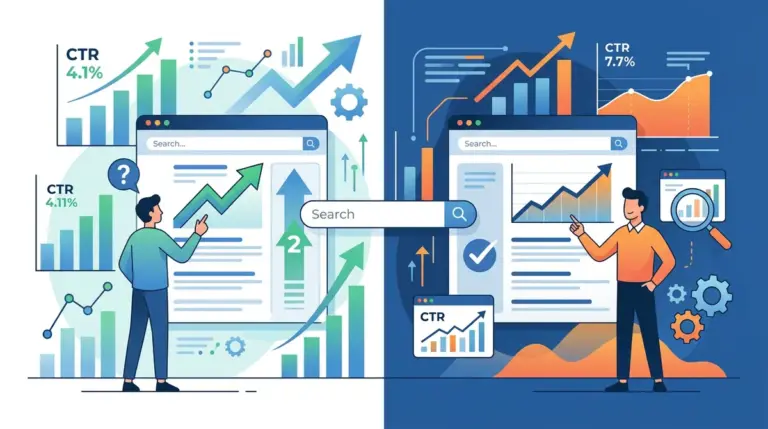
A high search ranking is a wasted asset if the title tag fails to trigger a click. In a saturated SERP environment, searchers have developed a sophisticated cognitive filter for "template" headlines. When every result on page one promises the "Ultimate Guide to [Keyword]" or "10 Best [Product] for 2024," the user’s brain defaults to pattern recognition, filtering out these generic entries as low-value or AI-generated noise. To capture traffic, a headline must break the pattern by offering a specific, high-utility promise that aligns exactly with the user’s immediate intent. Understanding this dynamic is key to crafting titles that stand out and drive traffic, so consider how competitor headlines impact your click-through rates.
The Cognitive Filter: Why Users Scan Past Templates
Searchers do not read SERPs; they scan for "information scents." This behavior, rooted in information foraging theory, means users look for specific cues that a page contains the exact answer to their query. Generic headlines—those that rely on overused superlatives like "amazing," "best," or "comprehensive"—fail because they lack a unique information scent. They signal that the content is likely a rehash of every other top-ranking page.
Best for: Reducing bounce rates and increasing initial engagement by setting accurate expectations.
When a headline looks like a template, the searcher assumes the content is also a template. This leads to "banner blindness" for organic results. If your title tag for a "SaaS pricing" query is simply "SaaS Pricing Guide," you are competing on brand alone. If your title is "Why We Switched to Usage-Based Pricing (and Saved 22%)," you have provided a specific narrative and a measurable outcome that generic competitors cannot match. By presenting a quantifiable result, you offer a compelling reason to click, demonstrating the impact of numbers on headline performance.
The Specificity Gap and Trust Signals
Specificity is the most effective way to bypass the user’s mental spam filter. Vague headlines suggest a lack of expertise. Concrete headlines suggest data-backed insights. A searcher looking for "how to improve site speed" is more likely to click a result that says "How We Reduced LCP by 1.4 Seconds on Shopify" than one that says "Top Tips for Faster Websites."
The Power of Non-Rounded Numbers
Rounded numbers (10, 20, 50) look like editorial guesses. Non-rounded numbers (17, 34, 102) look like data. In CTR testing, headlines featuring specific, odd numbers often outperform those with "clean" numbers because they imply a rigorous selection process rather than a listicle built to fill a template.
Front-Loading the Value Proposition
With mobile screens and desktop sidebars often truncating titles after 55-60 characters, the most specific information must appear in the first 30 characters. Generic headlines often waste this "prime real estate" on brand names or repetitive category labels. Pro Tip: Place your primary differentiator—the specific benefit or the unique data point—at the very beginning of the tag.
Warning: Avoid "Clickbait Drift." If your headline promises a specific 22% improvement but the article only discusses general best practices, your dwell time will collapse. Google’s algorithms track these "short clicks," and your rankings will eventually drop to match your poor user engagement.
Matching Headline Structure to Search Intent
Generic headlines often fail because they use the wrong "intent hook" for the query. A user searching for a "comparison" wants a different headline structure than a user searching for a "definition."
- Informational Intent: Focus on the "How-To" or the "Mechanism." (e.g., "How to Fix [Error] Without Reinstalling")
- Commercial Intent: Focus on the "Selection Criteria" or "Hidden Costs." (e.g., "5 Best CRM Tools for Teams Under 10 People")
- Transactional Intent: Focus on "Availability," "Price," or "Speed." (e.g., "Next-Day Delivery on [Product] - In Stock")
Best for: Improving conversion rates by aligning the click with the user's stage in the buying funnel.
Testing Headlines in Paid Search Before SEO Deployment
One of the most expensive mistakes an SEO can make is "guessing" which headline will work and waiting three months for organic data to confirm it. Instead, use PPC (Pay-Per-Click) testing to validate headline performance in real-time. By running two or three variations of a headline as Google Ads for the same target keyword, you can gather statistically significant CTR data within days.
This data allows you to see which specific hooks—whether it’s a "price" hook, a "speed" hook, or a "fear of missing out" hook—actually drive clicks. Once a winner is identified in the paid environment, you can deploy that headline as your organic H1 and Title Tag with a high degree of confidence that it will outperform the generic competition.
The "So What?" Test for Editorial Titles
Before finalizing any headline, apply the "So What?" test. If a searcher reads your headline and can ask "So what?" without receiving a clear answer, the headline is too generic.
Example: "New SEO Strategies for 2024." So what? Revised: "Why Backlinks Matter Less in 2024 (and What to Build Instead)." This version provides a clear pivot and a specific action, making it much harder for a searcher to ignore.
Immediate Steps to Audit Your Title Tags
To move away from generic headlines and start capturing more of your existing impressions, follow this implementation sequence:
First, identify your "High Impression, Low CTR" pages in Search Console. These are pages where the ranking is sufficient, but the headline is failing to convert the view into a visit. Focus your optimization efforts here first, as these offer the fastest ROI. Replace any "Ultimate Guide" or "Best [Keyword]" titles with specific, data-driven alternatives. Ensure that your primary keyword is present but secondary to the unique value proposition. Finally, monitor the "average position" versus "CTR" over the next 30 days. If the position remains stable but the CTR increases, you have successfully broken the searcher's pattern recognition and claimed a larger share of the market without needing to build a single new backlink.
Frequently Asked Questions
Does changing a title tag for CTR affect my keyword rankings?
Yes. While the primary goal is to increase clicks, the Title Tag remains a core ranking signal. Ensure your primary keyword remains near the front of the tag. However, a higher CTR can indirectly improve rankings over time as search engines interpret the high click volume as a signal of relevance and quality.
How long should I wait before deciding a new headline has failed?
For high-traffic pages, 1,000 impressions is generally the minimum threshold for a statistically significant comparison. For lower-traffic pages, give the new headline at least 30 days to account for weekly fluctuations in search behavior.
Should I use brackets or parentheses in my headlines?
Data from various CTR studies suggests that using brackets—such as [New Data] or [Template Included]—can increase CTR by up to 40%. They act as a visual break in the text and highlight a specific "bonus" that generic headlines lack.