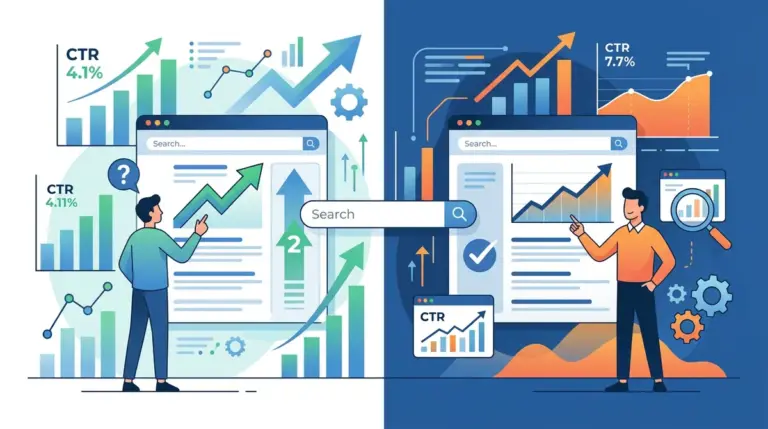
Search engine results pages are not static displays of information; they are high-stakes auctions for human attention. When a user scans a SERP, they are subconsciously performing a comparative analysis of ten blue links in under two seconds. Your click-through rate (CTR) is rarely a reflection of your headline's quality in isolation. Instead, it is a measurement of how your headline contrasts against the nine other options surrounding it. If every competitor is promising a "Complete Guide," your "Complete Guide" is invisible. To capture the click, you must exploit the gaps your competitors have left in the search intent landscape.
The Mechanics of SERP Contrast and the Isolation Effect
In cognitive psychology, the Von Restorff effect suggests that when multiple similar objects are present, the one that differs from the rest is most likely to be remembered and selected. In the context of SEO, this means that if the top five results all lead with "10 Best CRM Softwares for 2024," a headline that reads "Why We Switched from Salesforce to [Brand]" will naturally draw the eye because it breaks the established pattern of the listicle format.
Best for: High-competition commercial keywords where the SERP has reached "semantic saturation"—a state where every title tag looks nearly identical.
When competitors use identical modifiers like "Best," "Top," or "Cheap," they create a wall of text that users skim rather than read. By identifying the dominant archetype on a SERP, you can intentionally pivot to a different psychological trigger, such as curiosity, urgency, or loss aversion, to disrupt the user's scrolling pattern.
Identifying Semantic Saturation in Your Niche
Before drafting a title tag, audit the current top 10 results for your target keyword. You are looking for the "standardized vocabulary" of that specific SERP. If you see the same year, the same adjectives, and the same bracketed suffixes (e.g., [Updated for 2024]), you have found a saturated environment. This is an opportunity to use "Information Gaps"—headlines that pose a question or provide a specific, data-driven result that the generic guides are missing.
Analyzing Competitor Sentiment and Tone
Competitor headlines generally fall into three tonal categories: clinical/authoritative, aggressive/sales-driven, or educational/helpful. If the SERP is dominated by clinical definitions, an aggressive, opinionated headline often wins the click. Conversely, if the page is filled with "Hard Sell" copy, a neutral, data-heavy headline can act as a palate cleanser for a skeptical searcher.
- The Contrarian Approach: If everyone is writing "How to Save Money on X," write "Why Saving Money on X is a Mistake."
- The Specificity Play: Replace generic terms like "Improve Results" with concrete figures like "Boost ROI by 22%."
- The Bracketed Value Add: Use [Template], [Case Study], or [Video] to signal a higher utility than a standard blog post.
- The Temporal Shift: If competitors are focused on "2024," focus on "The Next 5 Years" to position yourself as a forward-thinking authority.
Warning: Avoid "Clickbait Decay." While extreme contrast can drive an initial spike in CTR, if your landing page content does not immediately satisfy the specific promise made in your disruptive headline, your bounce rate will surge, and your rankings will eventually plummet. Contrast must be backed by relevance.
Technical Headline Constraints vs. Competitor Bloat
The physical real estate of the SERP is limited to approximately 580 to 600 pixels for desktop titles. Many SEOs focus so heavily on keyword inclusion that their headlines truncate, ending in an unsightly "...". This is a competitive advantage for you. If your competitors have bloated, truncated titles, a short, punchy headline that fits entirely within the viewable area will appear more professional and trustworthy.
Analyze the "pixel density" of the current top results. If the top three results are all 65+ characters, a 45-character headline with significant white space around it will stand out. This "visual breathing room" makes your result easier to process, which is a significant factor in rapid-fire decision-making.
The Power of the "Negative" Headline
Research into CTR often shows that negative superlatives (e.g., "Worst," "Avoid," "Stop") can outperform positive ones (e.g., "Best," "Always"). This is due to loss aversion; humans are more motivated to avoid a mistake than to achieve a gain. If your competitors are all promising "Success Tips," you can often capture a higher CTR by highlighting "Critical Failures to Avoid." This creates a sense of protective urgency in the user.
Leveraging Secondary SERP Features to Outshine Headlines
Your headline does not work alone. It is supported by your meta description and, crucially, your rich snippets. If a competitor has a strong headline but lacks "Review Schema" (stars) or "FAQ Schema," your result can still win the click by occupying more vertical space. However, the headline remains the primary anchor. Ensure your headline directly addresses the "User Intent" that the rich snippets are supporting. For example, if you are using FAQ schema, your headline should be framed as the definitive answer to the primary question in that set.
Building a Headline Testing Framework
To consistently beat competitor CTRs, you must move away from "set and forget" SEO. Implement a testing cycle where you change title tags every 14 to 30 days for high-volume pages. Measure the impact of different variables:
1. The "Number" Test: Compare odd numbers vs. even numbers in listicles (odd numbers often perform better).
2. The "Parentheses" Test: Adding (New Data) or (Step-by-Step) to the end of a title.
3. The "Action Verb" Test: Starting the headline with a strong command like "Stop," "Build," or "Eliminate."
By systematically varying these elements against the current SERP leaders, you can identify the specific psychological triggers that resonate with your particular audience segment.
Frequently Asked Questions
How often should I change my headlines to compete?
Do not change headlines more than once every two weeks. You need a statistically significant number of impressions to determine if a change in CTR is due to the headline or external factors like seasonality or algorithm shifts.
Does a higher CTR always lead to better rankings?
Not directly, but high CTR combined with high dwell time signals to search engines that your result is the most relevant for that query. Over time, this "user satisfaction" signal is a primary driver for upward mobility in the SERPs.
Should I copy a competitor's headline if they are in position one?
No. If you copy the leader, you are reinforcing their dominance by offering the user more of the same. To take the top spot, you must offer a distinct "Unique Selling Proposition" (USP) in your headline that makes the current leader look outdated or incomplete.
What is a good CTR for an organic search result?
CTR varies wildly by industry and intent. However, for a position one result, 25-30% is standard. If you are in position three and seeing less than 8-10%, your headline is likely failing to differentiate itself from the results above it.