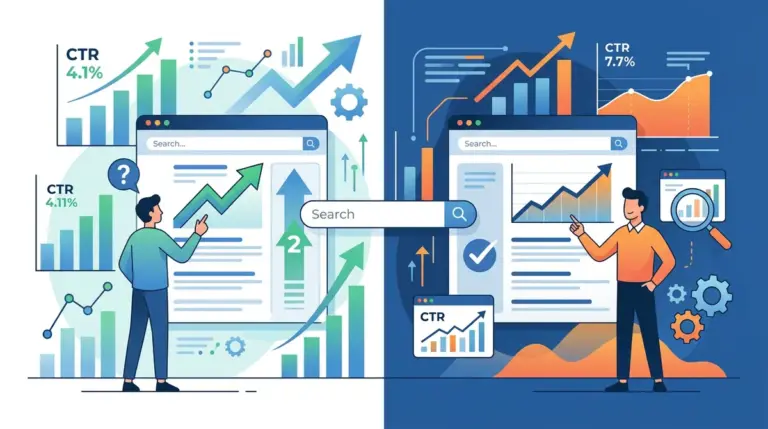
Adding a year or a specific month to a title tag is one of the lowest-effort, highest-return optimizations in the SEO toolkit. For high-intent queries where recency implies accuracy—such as software reviews, tax laws, or marketing trends—a date acts as a trust signal that can swing click-through rates (CTR) by 20% or more. However, the strategy carries a hidden "maintenance debt." If you fail to update that date as the calendar turns, your click-through rate will collapse as users perceive the content as obsolete. The decision to include dates must be based on the specific search intent of the keyword rather than a blanket site-wide policy.
The Psychology of the Freshness Signal
Searchers are conditioned to filter for the most current information. In a SERP crowded with similar headlines, the presence of the current year—often enclosed in brackets or parentheses—serves as a visual anchor. It tells the user that the information has been vetted for the current landscape. This is particularly effective for "Best of" lists, pricing guides, and "How-to" articles in fast-moving industries like technology or finance.
Best for: Comparison pages, seasonal buying guides, and regulatory updates where "new" equals "correct."
When a user sees "[2024]" in a title, they aren't just looking for the date; they are looking for a guarantee of relevance. For example, a search for "Best SEO Tools" will favor a result with the current year because the software landscape changes monthly. Without the date, the user assumes the list might include defunct tools or outdated pricing models. This psychological shortcut bypasses the need for the user to read the meta description, leading to an immediate click.
Quantifying the CTR Lift Across Different Niches
The impact of dates is not uniform across all categories. In evergreen niches, the lift is marginal. In "YMYL" (Your Money, Your Life) categories, it is mandatory.
- Software and SaaS: High impact. Users need to know features and UI screenshots are current. Adding a year can increase CTR by 15-30%.
- Legal and Finance: Critical impact. Tax codes or visa requirements from 2022 are useless in 2024. Titles without dates often see a 40% lower CTR than those with them.
- Recipe and Lifestyle: Low impact. A beef stew recipe from 2018 is usually as valid as one from 2024. Adding a date here can actually look like "over-optimization" and may deter savvy users.
- News and Trends: High impact, but usually handled by Google’s "date published" snippet rather than the title tag itself.
The "Updated" Modifier vs. The Static Year
There is a distinct difference in performance between simply adding "2024" and using phrases like "Updated for 2024." The latter implies an editorial review occurred. Data suggests that "Updated" or "Revised" modifiers perform better for long-form guides, while a simple year in brackets works best for product listicles. The bracketed year acts as a suffix that doesn't disrupt the primary keyword flow, maintaining the integrity of the title's front-loaded SEO value.
Warning: Never use a date in a URL slug (e.g., /best-laptops-2023/). While a title tag can be changed in seconds, changing a URL requires a 301 redirect, which can cause temporary ranking fluctuations. Keep the URL evergreen and the title tag dynamic.
The Maintenance Debt: When Dates Destroy CTR
The biggest risk of using dates is the "January 1st Problem." On the first day of a new year, every title tag containing the previous year becomes a liability. A title saying "Best CRM Software 2023" viewed in January 2024 signals to the user that the content is at least a year old, even if the information is still accurate. This leads to a precipitous drop in CTR as users scroll past to find a result that mentions the current year.
To mitigate this, agencies and publishers must use automated solutions. Most modern SEO plugins allow for dynamic variables (e.g., %%currentyear%%). This ensures that the title tag updates automatically across thousands of pages without manual intervention. However, there is an ethical and algorithmic risk: if you update the year in the title but the content remains identical to the previous year, Google may eventually stop honoring the title change in the SERP, or users may bounce immediately, hurting your "dwell time" metrics.
Strategic Implementation Patterns
How you place the date matters for both the algorithm and the human eye. The goal is to maximize visibility without truncating the core keyword string.
Pattern 1: The Suffix Bracket
Example: Best Project Management Software [2024 Review]
This is the most common and effective pattern. It keeps the keyword at the front for ranking purposes and places the "freshness" signal at the end where it catches the eye before the user moves to the next result.
Pattern 2: The Parenthetical Update
Example: How to Start an LLC (Updated Oct 2024)
Using the month and year is highly effective for topics that change frequently, such as state-specific regulations or social media algorithms. It suggests a level of granularity that a simple year cannot match.
Pattern 3: The Leading Date
Example: 2024 Guide: How to Optimize for Voice Search
This is generally less effective for SEO because it pushes the primary keyword further to the right. However, for established brands with high authority, it can work as a "thought leadership" signal.
Optimizing Title Tags for Maximum Conversion
To move beyond a simple year, consider the context of the search. If you are targeting a "Best of" query, the date should be paired with a quantity or a superlative. "10 Best Laptops [2024]" is a standard high-performer. If the query is "How to," the date should be paired with a "Step-by-Step" or "Current" modifier.
A/B testing title tags with and without dates is the only way to confirm the lift for your specific audience. Use Google Search Console to monitor the CTR of a specific URL for 30 days with a date-less title, then introduce the year and monitor for another 30 days. Ensure you account for seasonal traffic shifts during this period. If the CTR increase is less than 5%, the maintenance of that date may not be worth the effort unless it can be fully automated.
Executing a Dynamic Date Strategy
To implement this at scale without risking your rankings, follow these operational steps:
- Identify pages where recency is a primary conversion driver (Reviews, Guides, Pricing).
- Use CMS variables to inject the current year into the SEO title field automatically.
- Schedule a quarterly editorial audit to ensure the content actually reflects the "current" year mentioned in the title.
- Monitor Search Console for "stale" clicks—pages where the year in the snippet doesn't match the current date.
- Avoid adding dates to purely evergreen content like "History of the Internet" or "What is a URL."
By treating the date as a functional element of the user interface rather than just a keyword, you align your site with the user's desire for the most relevant, up-to-date information available.
Frequently Asked Questions
Does Google penalize you for changing dates in titles?
No, Google does not penalize title changes. In fact, Google encourages site owners to keep their metadata accurate. However, if you change the date without updating the content, and users bounce quickly, your rankings may eventually drop due to poor engagement signals.
Should I put the month and the year in the title?
Only if the topic is extremely volatile. For most B2B and consumer queries, the year is sufficient. Adding the month can lead to title truncation on mobile devices, hiding the most important parts of your headline.
Can I use "Current" instead of a specific year?
You can, but it is generally less effective. "2024" is a concrete data point that users can verify instantly. "Current" is vague and often used by low-quality sites to avoid updating their content, which savvy users have learned to ignore.
What happens if I forget to update the year?
Your CTR will likely drop significantly as soon as the new year begins. Users perceive an old date as a sign of neglected content. If you cannot commit to an automated or manual update schedule, it is better to omit the date entirely.