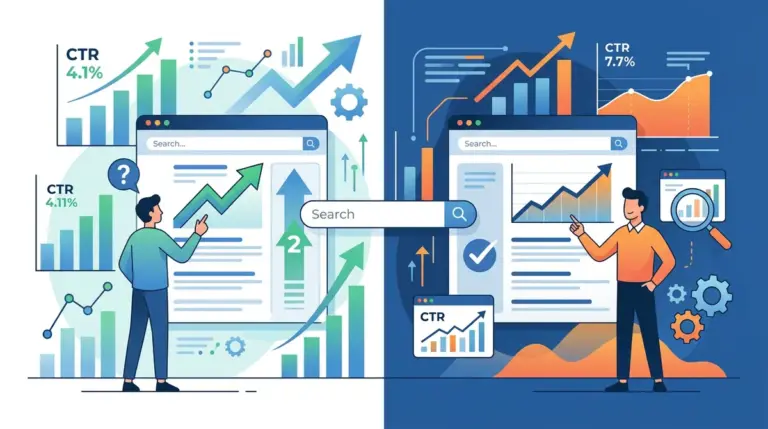
Marketers treat numbers in headlines as a default setting, but the actual lift in Click-Through Rate (CTR) depends on the specific digit, its position, and the user’s intent. While general industry lore suggests that numbers increase engagement by 36%, the reality is more nuanced. For an SEO professional or a media buyer, the goal isn't just to "use a number," but to leverage the specific cognitive shortcuts that digits trigger in a crowded SERP or social feed.
The Cognitive Load Factor in Search Results
Humans are biologically wired to notice contrast. In a sea of alphabetic characters, digits provide immediate visual relief. This is known as "linguistic saliency." When a user scans a search results page, their eyes move in an F-shaped pattern, looking for anchors that promise a specific, quantifiable payoff. A headline like "Ways to Improve ROI" is abstract; "11 Ways to Improve ROI" is a concrete commitment of time and value.
Numbers signal that the information is organized and finite. This reduces the perceived cognitive load required to consume the content. For publishers, this translates to a lower bounce rate from the SERP because the user knows exactly what they are clicking into—a list, a percentage, or a specific dollar amount.
The Odd Number Bias: Why 7 Beats 10
Data from large-scale content aggregators consistently shows that odd numbers outperform even numbers by approximately 20%. The "Rule of Three" or the "Rule of Five" provides a sense of symmetry that the brain often dismisses as "too perfect" or manufactured. Odd numbers, particularly 7, 9, and 11, feel more authentic and less like a marketing template.
The Specificity Effect in Data Reporting
When using numbers to denote statistics or results, precision beats rounding every time. A headline claiming a "15% increase in traffic" feels like an estimate. A headline claiming a "14.7% increase" suggests a rigorous data set. In high-stakes B2B environments, this specificity builds immediate authority. If you are reporting on a case study or a technical audit, use the exact decimal. It signals to the professional reader that the work behind the headline is granular and verified.
Warning: Avoid "Number Inflation" in your headlines. If you promise 50 tips but 40 of them are filler, you will see a high CTR but a devastatingly low dwell time. This sends a negative signal to search engines regarding content quality, eventually tanking your rankings despite the high initial click volume.
Formatting for Maximum Visual Impact
The way a number is presented is just as important as the number itself. In almost every split test, digits (7) outperform written words (Seven). Digits act as "eye-stoppers" because they break the flow of standard text.
- Start with the digit: Headlines that begin with a number capture attention faster than those that bury the number in the middle.
- Use brackets for context: Combining a number with a bracketed clarification—e.g., "7 CTR Hacks [2024 Data]"—provides a double hook of quantification and freshness.
- Avoid large, unreadable strings: Instead of "1,000,000," use "1 Million" for better readability in mobile search results where character space is at a premium.
Vertical-Specific Benchmarks for Number Usage
The effectiveness of numbers fluctuates based on the industry and the platform. In E-commerce, numbers are most effective when they denote savings or scarcity ("Save $40" or "Only 3 Left"). In SaaS and B2B, numbers are better used to quantify efficiency or scale ("Reduce Churn by 12%" or "Trusted by 5,000+ Engineers").
Best for SEO: Listicles and "How-To" guides where the number represents the volume of solutions provided. This satisfies the "comprehensive" intent that Google's Helpful Content updates tend to favor.
Best for PPC: Specificity and social proof. Using a number like "4.9/5 Star Rating" in an ad headline directly addresses the user's risk-aversion, leading to a measurable decrease in Cost Per Click (CPC) as the Quality Score improves due to higher relevance.
The "Price Anchor" Strategy in Headlines
For transactional queries, including a price in the headline can actually lower CTR but significantly increase conversion rates. This is a strategic trade-off. By including "Starting at $19," you filter out low-intent users who are looking for free solutions, ensuring that the clicks you do pay for are from qualified leads. This improves the overall health of your marketing funnel even if the raw CTR percentage drops.
Testing and Validating Headline Performance
You should never assume a number will work without validation. A/B testing headlines via Google Ads or social media creative testing is the only way to find the "sweet spot" for your specific audience. Sometimes, a "How-To" headline without a number will outperform a listicle if the user is looking for a deep-dive philosophical explanation rather than a quick-fix list.
Use tools to track the "Position vs. CTR" delta. If you are ranking in position 3 but getting the CTR of position 1, your headline (and its use of numbers) is doing the heavy lifting. If you are in position 1 but getting position 3 clicks, your headline is likely too generic or lacks a compelling numerical hook.
Executing a Data-Driven Headline Overhaul
To implement these findings, start by auditing your top 20 highest-traffic pages. Identify headlines that are purely descriptive and lack a numerical anchor. Experiment by adding a specific count, a percentage of improvement, or a timeframe for results. Monitor the Search Console data for 30 days to see if the CTR fluctuates.
Remember that the number must be reflected in the H1 and the body copy. If the headline promises "9 Strategies" but the article only lists 7, you lose user trust and increase the likelihood of a "pogo-sticking" effect, where users jump back to the search results to find a more accurate source. Specificity, honesty, and visual contrast are the three pillars of using numbers to drive clicks.
Frequently Asked Questions
Do numbers in headlines work for every niche?
While numbers generally improve CTR, they are less effective in creative writing, high-end luxury branding, or deep academic research where listicles can cheapen the perceived value of the information. In technical and commercial niches, however, they are nearly universal in their effectiveness.
Should I use a comma in large numbers within a headline?
For numbers over 9,999, use commas to improve readability. For numbers under 10,000, it is often better to omit the comma to save character space in mobile SERPs, unless the comma is necessary for clarity.
Is there a limit to how many numbers I should use?
Yes. A headline like "5 Ways to Save $500 in 5 Days" is too repetitive and can look like spam. Stick to one or two primary numerical hooks to maintain a clean, professional appearance.