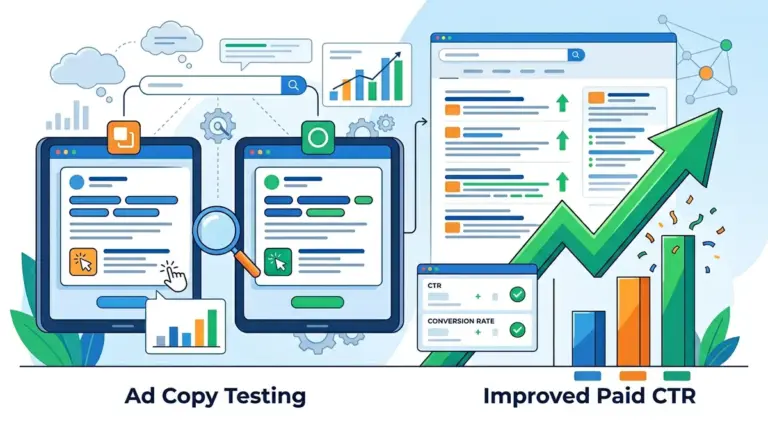
A "good" Google Ads click-through rate (CTR) is not a static benchmark; it is a relative metric defined by your industry, the network you are using, and the intent of your keyword clusters. If your Search campaigns are hovering around 2%, you are likely underperforming against the cross-industry average of 4% to 6%. However, for high-competition sectors like legal services or insurance, a 3% CTR might represent a highly efficient result, while a branded search campaign should rarely drop below 10%.
Understanding where your performance sits requires moving past generic averages and looking at the mechanics of the Google Ads auction. CTR is the primary lever in the Quality Score formula. A higher CTR signals to Google that your ad is relevant, which in turn lowers your Cost Per Click (CPC) and improves your Ad Rank. Improving your CTR is not just about getting more traffic; it is about reducing the tax you pay to Google for every click you receive.
Industry Benchmarks and the Search vs. Display Divide
The gap between Search and Display CTRs is massive because the user intent is fundamentally different. On the Search Network, users are actively looking for a solution. On the Display Network, you are interrupting their browsing experience. Consequently, the benchmarks for success are worlds apart.
- Search Network: A healthy average across all industries is approximately 5%. Top-tier performers often see 8% or higher on non-branded terms.
- Display Network: A CTR of 0.50% to 1% is considered standard. Anything above 1% on Display suggests exceptionally strong creative or highly targeted placements.
- Shopping Ads: These typically see lower CTRs than text ads (often 0.80% to 1.5%) because users often "window shop" by looking at prices and images without clicking.
Industry-specific data further refines these goals. For example, the Real Estate and Home Services sectors often see Search CTRs exceeding 7% due to high local intent. Conversely, the B2B and Legal sectors often struggle to break 4% because the decision-making process is longer and the ad copy is often more restrictive and less "clicky."
The Mathematical Link Between CTR and Ad Rank
Google does not reward the highest bidder; it rewards the highest "value" bidder. Ad Rank is calculated using your Max CPC bid, your Quality Score, and the expected impact of ad extensions. Since CTR is the most significant component of Quality Score, a low CTR directly forces you to bid higher to maintain the same position as a competitor with a better-performing ad.
Impact on CPC: If your CTR is significantly below the expected CTR for your position, Google penalizes your Quality Score. A Quality Score of 3 or 4 can increase your CPC by 100% or more compared to the benchmark. Conversely, a Quality Score of 10 (driven by a high CTR) can result in a 50% discount on your CPC. This is why chasing a "good" CTR is a financial necessity, not just a marketing goal.
Why Brand Keywords Skew Your Data
When auditing an account, you must segment branded keywords from non-branded keywords. Branded CTRs (e.g., someone searching for your specific company name) should realistically be between 10% and 30%. Because these users are already looking for you, the relevance is near-perfect.
If your branded CTR is low, it is an immediate red flag. It usually indicates that a competitor is bidding on your brand name and winning the top spot, or that your ad copy is so poorly aligned with your brand identity that users are clicking on organic results instead. Mixing these high-performing branded terms with your generic "prospecting" terms will give you a false sense of security regarding your account-wide CTR.
Variables That Distort Your CTR Data
Not all clicks are created equal, and several factors can artificially inflate or deflate your CTR without reflecting the actual quality of your marketing.
Ad Position: The ad in the top spot will naturally have a higher CTR than the ad in position four, regardless of copy quality. When evaluating CTR, look at the "Top of Page" and "Abs. Top of Page" metrics to see if your CTR is high because the ad is good or simply because you are overpaying for the first position.
Match Types: Broad match keywords typically have lower CTRs because they trigger for a wider, less relevant range of queries. Exact match keywords should have the highest CTRs. If your exact match terms have a low CTR, your ad copy is failing to address the specific intent of that keyword.
Warning: Be wary of high CTRs on mobile Display campaigns. Often, a spike in CTR on mobile apps is the result of "fat-finger" clicks or accidental engagement with interstitial ads. If your CTR is 3% on Display but your bounce rate is 98%, you are paying for accidental traffic, not interested prospects.
Tactical Adjustments to Force CTR Growth
If your CTR is below the 4% Search baseline, you need to implement structural changes to your account. This is not about changing a single word; it is about improving the "Search-to-Ad" alignment.
1. Aggressive Negative Keyword Pruning: Low CTR is often caused by your ad appearing for irrelevant queries. Review your Search Terms Report weekly. If you sell "luxury watches," but your ad is appearing for "cheap watch repair," your CTR will suffer. Exclude these terms to stop the impressions that aren't converting.
2. Utilize All Relevant Ad Extensions: Sitelinks, Callouts, and Structured Snippets increase the physical footprint of your ad. A larger ad is more visible and offers more "click targets." Accounts that use at least four sitelinks typically see a 10-15% lift in CTR compared to those that don't.
3. Refine Responsive Search Ads (RSAs): Google’s AI needs high-quality inputs. Ensure you are using all 15 headlines and 4 descriptions. Include your primary keyword in at least two headlines. Use "Action" language (e.g., Get a Quote, Download Now, Shop the Sale) to give the user a clear reason to click.
Auditing Your Performance for Real Growth
To determine if your CTR is actually "good," you must look at it in the context of your conversion rate. A high CTR with a low conversion rate means you are great at baiting clicks but bad at fulfilling the promise on the landing page. This is a recipe for burning budget.
Compare your CTR against your historical data. If you were at 3% last quarter and you are at 4% now, you are moving in the right direction, regardless of industry averages. The goal is to maximize the "Expected CTR" component of your Quality Score to ensure you are winning the auction at the lowest possible price point.
Frequently Asked Questions
Is a 2% CTR good for Google Ads?
On the Search Network, 2% is generally considered below average. Most advertisers should aim for at least 4-5%. On the Display Network, however, 2% would be considered exceptional, as the average is usually below 1%.
Does a higher CTR always mean more profit?
Not necessarily. A high CTR can be a vanity metric if the clicks are coming from irrelevant search terms. You must balance CTR with conversion rate and Cost Per Acquisition (CPA) to ensure the traffic is actually valuable.
How long should I wait before judging my CTR?
Wait until you have at least 1,000 impressions for a specific keyword or ad group. Anything less is statistically insignificant and can be skewed by a few random clicks or a single day of high-volume, low-intent traffic.
Why did my CTR suddenly drop?
The most common reasons are increased competition (a new player bidding for the top spot), ad fatigue (users have seen your creative too many times), or a change in your match types that is triggering your ad for broader, less relevant searches.