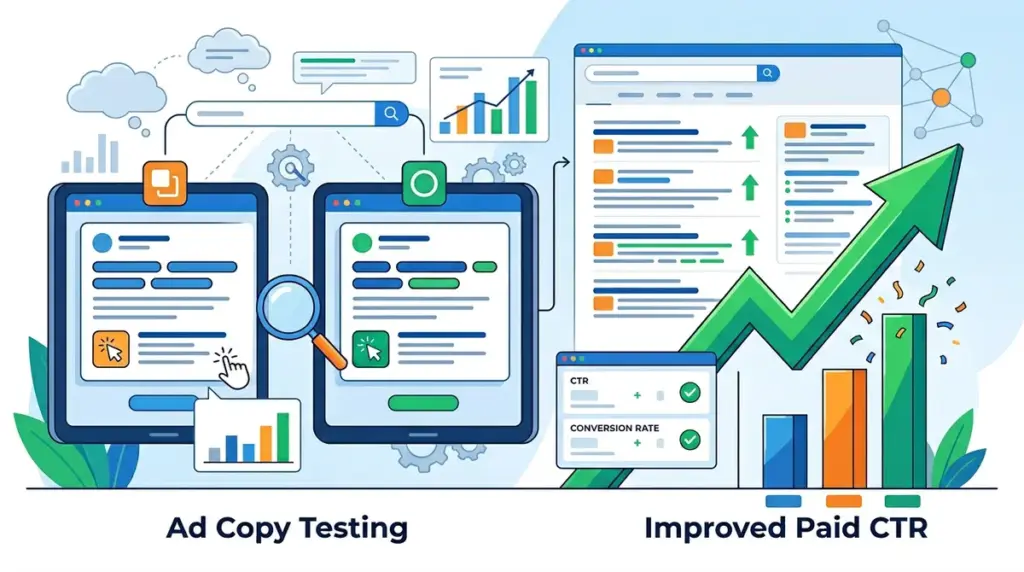
Paid search is a zero-sum game where the highest click-through rate (CTR) usually dictates the lowest cost per acquisition. While many advertisers obsess over bid strategies and keyword match types, the actual ad creative is the primary lever for improving Quality Score. High CTR signals to Google and Bing that your ad is relevant, which triggers a downward pressure on your cost-per-click (CPC). Ad copy testing is the systematic process of finding the specific language, offers, and psychological triggers that force a user to stop scrolling and click.
The Direct Link Between CTR and Ad Rank
Ad Rank determines your position on the page and is calculated using your bid amount, the auction-time ad quality (including expected CTR), and the expected impact of assets. When you improve your CTR through rigorous copy testing, you are effectively increasing your "Expected CTR" component. This allows you to outrank competitors who may be bidding more but have lower-quality, less relevant ads.
Impact on CPC: A high CTR doesn't just get you more traffic; it makes that traffic cheaper. Google rewards high-CTR ads with a higher Quality Score, which acts as a discount on your actual CPC. Conversely, a poor CTR penalizes you, forcing you to pay a premium just to maintain visibility.
Isolating Variables in Responsive Search Ads
The shift to Responsive Search Ads (RSAs) changed the testing landscape. Instead of testing two static ads against each other, you are now testing assets within a machine-learning framework. However, relying solely on Google’s "Ad Strength" metric is a mistake. Ad Strength measures diversity of content, not the actual performance of the copy.
Headline Testing: The 80/20 Rule
The headline is the most influential part of your ad. Testing different value propositions in Headline 1 and Headline 2 yields the most significant data. You should test three distinct angles:
- Utility-focused: Focus on the specific problem the product solves (e.g., "Stop Leakage in 5 Minutes").
- Social Proof: Use numbers and testimonials (e.g., "Trusted by 50,000+ Engineers").
- Loss Aversion: Highlight what the user loses by not clicking (e.g., "Don't Overpay for Insurance").
The Role of Pinning in Scientific Testing
To conduct a true A/B test in an RSA environment, you must use pinning. By pinning specific headlines to Position 1 and Position 2 across two different ads, you can isolate which messaging resonates better. Without pinning, the algorithm mixes assets, making it nearly impossible to determine which specific phrase drove the performance lift.
Warning: Avoid testing too many variables simultaneously. If you change the headline, the description, and the display URL all at once, you won't know which change caused the shift in CTR. Test one element per ad group until you reach statistical significance.
Psychological Triggers That Move the Needle
Effective ad copy isn't just about being descriptive; it’s about being provocative. Specificity beats generalities every time. Instead of saying "Low Prices," use "Starting at $19.99." Instead of "Fast Shipping," use "Ships Within 24 Hours."
Best for High-Intent Queries: Use "Dynamic Keyword Insertion" (DKI) sparingly. While it can improve relevance, it often leads to grammatically awkward headlines that look like bot-generated spam. Use DKI for broad terms, but write manual, high-impact copy for your most expensive, high-converting keywords.
Testing Call to Action (CTA) Variations
The CTA is often the most neglected part of ad copy. "Learn More" is passive. "Get Your Free Audit" or "Save 20% Today" provides a clear reason to act. In your testing rotation, try moving the CTA from the second description to the second headline. Visibility matters as much as the words themselves.
Statistical Significance and Data Volume
A common pitfall is ending a test too early. A 10% CTR on 50 impressions is noise; a 5% CTR on 5,000 impressions is a signal. Use a statistical significance calculator to ensure your results have at least a 95% confidence level before declaring a winner and pausing the underperforming ad.
Best for Low Volume Accounts: If your ad groups don't get enough traffic to reach significance in 30 days, aggregate your tests. Test the same two headline angles across five similar ad groups to gather data faster.
Operationalizing the Testing Cycle
Ad testing is not a "set it and forget it" task. It requires a repeatable cadence. A standard high-performance workflow looks like this:
- Identify the bottom 20% of ad groups by CTR.
- Analyze the winning ad copy in the top 20% of ad groups.
- Draft a "Challenger" ad for the low-performing groups based on those winning patterns.
- Run the test for 14 to 30 days depending on volume.
- Implement the winner and immediately start a new test.
Maximizing Return on Ad Spend Through Copy
To move beyond basic CTR improvements, you must align your ad copy with the landing page. If your ad promises a "50% Discount" but the landing page shows "Up to 30%," your bounce rate will spike, and your Quality Score will eventually drop despite a high initial CTR. The click is a promise; the landing page is the fulfillment. Testing copy that accurately reflects the offer on the page ensures that the traffic you drive is not just high in volume, but high in intent.
Refining the Display URL
The display URL is free real estate for keywords. Testing "Real CTR/Product-Name" versus "Real CTR/Free-Shipping" can provide a marginal but measurable lift in CTR. It reinforces the ad's relevance without taking up character space in the headlines or descriptions.
Standardizing Your Testing Protocol
Success in paid search is found in the margins. By shifting your focus from bidding nuances to the psychological triggers in your copy, you reduce your reliance on high bids to secure top positions. Every percentage point gained in CTR is a direct reduction in the cost of your leads. Start by auditing your top-spend ad groups and challenging the incumbent "Control" ad with a version that uses harder numbers, clearer CTAs, and more aggressive pinning strategies.
Frequently Asked Questions
How long should I run an ad copy test?
Most tests require at least 14 days to account for day-of-week fluctuations. However, the real metric is volume. Aim for at least 1,000 impressions per variation before making a decision.
Does a higher CTR always mean more profit?
Not necessarily. If your ad copy is "clickbaity" and doesn't filter for the right audience, you might see a high CTR but a very low conversion rate. Always monitor ROAS alongside CTR.
Should I use all 15 headlines in an RSA?
Quantity does not equal quality. It is better to have 5-7 highly distinct, well-written headlines than 15 repetitive ones. Google’s machine learning performs better when it has distinct concepts to test rather than minor synonyms.
What is the most important part of the ad to test?
Headline 1 is the most critical element. It is the first thing a user sees and carries the most weight in the click decision. Focus 70% of your testing energy there.