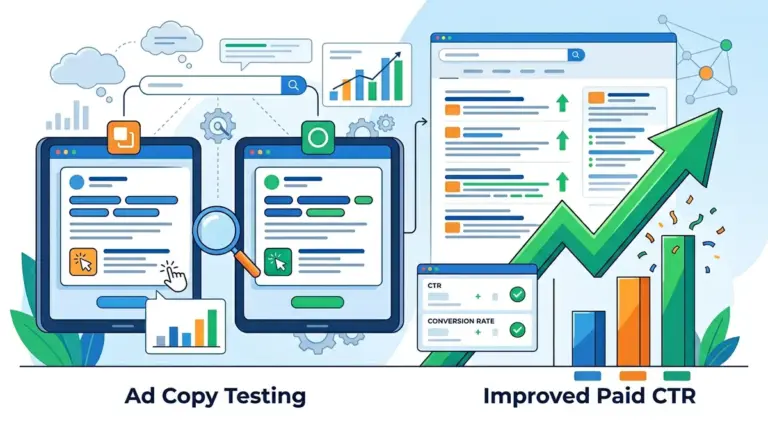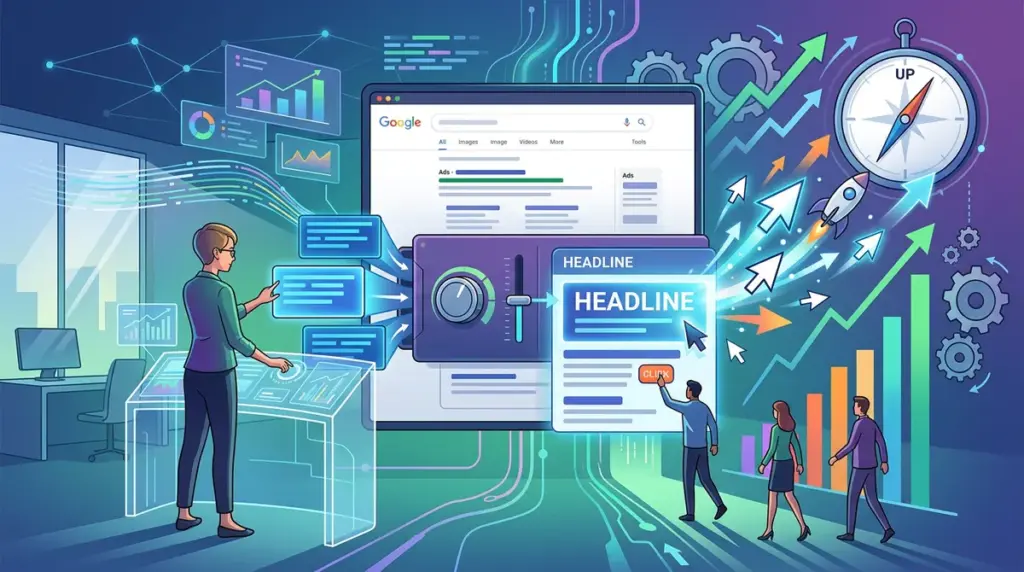
Google Ads headlines are the single most influential lever for Quality Score and Cost Per Click (CPC) efficiency. While descriptions provide context, the headline dictates the initial click-through rate (CTR), which informs Google’s "Expected CTR" algorithm. A low-performing headline doesn't just lose a click; it increases the price you pay for every subsequent impression by signaling to the auction that your ad is irrelevant. To maximize Real CTR, advertisers must move beyond creative guesswork and treat headline construction as a structural data exercise.
The Structural Mechanics of Responsive Search Ads (RSAs)
Modern Google Ads campaigns rely on Responsive Search Ads, allowing up to 15 headlines per ad unit. The common mistake is treating these 15 slots as a list of synonyms. When Google’s machine learning rotates headlines, it requires distinct variables to test. If ten of your headlines are variations of "Buy Software Now," the algorithm has no meaningful data to optimize against.
Effective RSA headline sets should be categorized into three functional groups:
- Direct Keyword Matches: At least three headlines must mirror the high-volume keywords in the ad group to ensure immediate relevance.
- Benefit-Driven Assertions: Focus on the outcome (e.g., "Reduce Churn by 15%") rather than the feature.
- Transactional Triggers: Specificity regarding pricing, shipping, or limited-time availability (e.g., "Free Shipping Over $50" or "Trial Ends Friday").
Strategic Pinning: Control vs. Machine Learning
Google encourages advertisers to leave headlines unpinned to allow for maximum permutations. However, from a conversion and brand safety perspective, this often leads to nonsensical combinations where two headlines say nearly the same thing. Pinning should be used strategically to force a logical narrative flow.
Best for Brand Integrity: Pinning the brand name or a specific "Must-See" offer to Position 1. This ensures that even if Google tests different benefits in Positions 2 and 3, the core identity of the ad remains constant. Be aware that pinning reduces the "Ad Strength" metric, but Ad Strength is a proxy for diversity, not a guarantee of performance. A "Good" ad with a pinned, high-converting headline often outperforms an "Excellent" ad that lacks a clear call to action.
Warning: Over-pinning (pinning every slot) effectively turns an RSA back into an Expanded Text Ad. This restricts the auction’s ability to match your creative to specific user signals, often resulting in a higher CPC due to lower predicted relevance.
Leveraging Specificity Over Vague Superlatives
Vague language like "Best Quality" or "Top Rated" is ignored by modern searchers. These are "invisible" words that consume your 30-character limit without adding value. To drive a higher CTR, replace adjectives with concrete data points. Instead of "Fast Shipping," use "Ships Within 24 Hours." Instead of "Trusted by Many," use "Used by 10,000+ Teams."
Numbers and symbols break the visual monotony of the search engine results page (SERP). Using a "/" to separate concepts or a "+" to denote added value draws the eye more effectively than a standard comma or period. For example, "SEO Audit + Strategy Map" is more clickable than "SEO Audit and Strategy Map."
The "Question and Answer" Framework
Search is inherently an interrogative medium. Users are asking Google a question. If your headline mirrors that question, you establish immediate alignment. If the user searches for "how to fix a leaky pipe," a headline that reads "Leaky Pipe? Fix it Today" performs better than a generic "Plumbing Services." This tactic utilizes the "Problem/Solution" psychological trigger, positioning your ad as the immediate resolution to the user's friction point.
Dynamic Keyword Insertion (DKI) and Customizers
DKI is a double-edged sword. It ensures the headline matches the search query exactly, which typically boosts CTR. However, if your keyword list includes broad or poorly matched terms, DKI can produce headlines that look robotic or nonsensical. Use DKI for high-intent, specific product keywords, but avoid it for broad category terms where a curated, benefit-led headline would be more persuasive.
Best for E-commerce: Use Ad Customizers to pull real-time inventory or pricing data into the headline. If a user sees "Only 3 Left in Stock" in a headline, the urgency is real and verifiable, which significantly outperforms artificial "Act Now" language.
Operationalizing the Headline Test
To improve CTR systematically, you must move away from "set it and forget it" workflows. Review the "Location" and "Asset" reports within Google Ads every 14 to 30 days. Identify which headlines are appearing in the "Top" performing combinations and which are rarely served. Google stops serving headlines that don't generate clicks; these "Low" performance assets should be cycled out for new variations immediately.
Focus on testing one variable at a time across your ad groups. For instance, test "Price in Headline" vs. "Benefit in Headline" across five different ad groups to see which trend holds true for your specific audience. This data-driven approach ensures that your CTR improvements are repeatable and not just the result of a single lucky creative choice.
FAQ: Optimizing Headline Performance
How many headlines should I actually use in an RSA?
While Google allows 15, you should aim for at least 8 to 10 distinct variations. Using all 15 often leads to "filler" content that dilutes the quality of the ad. Quality and distinctiveness are more important than hitting the maximum slot count.
Does headline length affect CTR?
Generally, longer headlines that utilize the majority of the 30-character limit perform better because they occupy more physical screen real estate, especially on mobile devices. However, ensure the most critical information is in the first 20 characters to avoid any potential truncation in certain layout formats.
Should I put my brand name in the headline?
If you are a well-known brand, including the name can increase trust and CTR. For smaller or niche companies, it is often more effective to use that space for a high-value benefit or a direct answer to the user's query, as the brand name may not yet carry significant "click-weight."