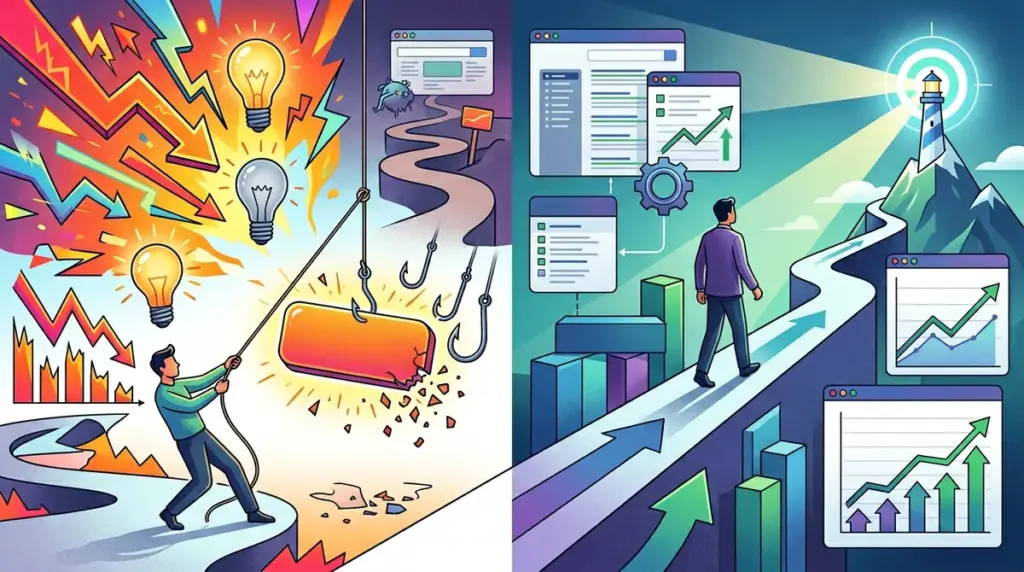
The delta between a click that converts and a click that bounces lies in the alignment of the meta description with the user’s immediate psychological state. For search marketers, the pressure to inflate click-through rates (CTR) often leads to a reliance on "clickbait"—copy that leverages curiosity gaps or hyperbole to drive traffic. However, high-intent SEO copy functions differently; it prioritizes relevance and qualification over raw volume. Choosing between these two approaches isn't just an editorial preference; it is a strategic decision that dictates your site's dwell time, conversion rate, and long-term standing in the SERPs. The pressure to inflate click-through rates (CTR) often leads to a reliance on "clickbait"—copy that leverages curiosity gaps or hyperbole to drive traffic, but there are ways of using curiosity without falling into clickbait.
The Psychological Arbitrage of the Curiosity Gap
Clickbait operates on the principle of information deprivation. By withholding the core value proposition of an article—using phrases like "You won't believe what happened next" or "The one secret trick"—the copywriter forces a click to resolve cognitive dissonance. In a vacuum, this maximizes CTR. In a commercial environment, it often backfires.
Best for: Social media distribution and high-volume viral news sites where ad impressions are the primary revenue driver and user intent is low-friction discovery.
When you use clickbait in SEO, you are essentially arbitrage-testing the user's patience. If the content behind the click does not immediately satisfy the curiosity gap created in the SERP, the user will "pogo-stick" back to the search results. Google’s algorithms interpret this rapid exit as a signal that the page is irrelevant or low-quality, eventually suppressing the ranking regardless of how many clicks the headline initially generated.
Why Clickbait Decays Long-Term SEO Equity
The primary risk of clickbait is brand erosion. When a professional or B2B buyer clicks a result expecting a technical solution and finds a listicle of surface-level platitudes, the trust is severed. High CTR at the expense of brand authority is a net loss. Furthermore, clickbait attracts "garbage traffic"—users who have no intention of buying, subscribing, or engaging beyond the initial curiosity hit. This skews your data, making it difficult to optimize conversion funnels because your baseline audience is misaligned with your product.
Engineering High-Intent SEO Copy for Conversion
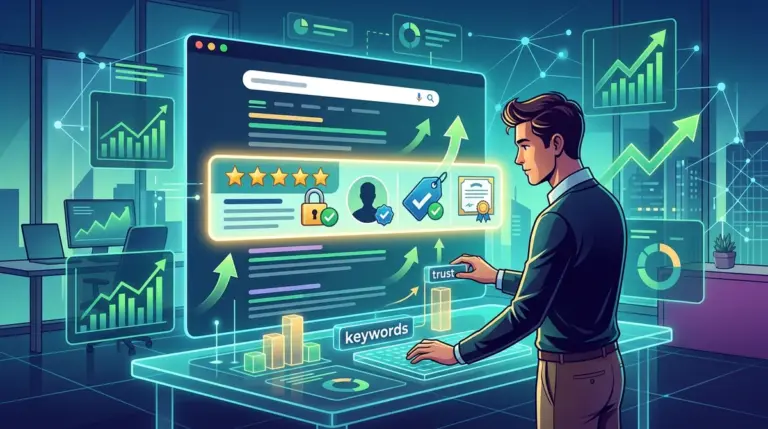
High-intent copy focuses on transparency. Instead of hiding the answer, it previews the solution. The goal is to attract the specific user who is ready to take action, whether that action is a purchase, a download, or a deep-dive read. High-intent CTR is often lower in raw percentage than clickbait, but the traffic it produces is significantly more valuable.
Best for: B2B SaaS, e-commerce product pages, technical guides, and service-based businesses where the cost-per-acquisition (CPA) is a critical KPI.
To write high-intent copy, you must identify the "searcher's task." If a user searches for "best enterprise CRM for healthcare," they aren't looking for a mystery; they are looking for a feature comparison, HIPAA compliance verification, and pricing. A high-intent headline would be: "Top 5 HIPAA-Compliant CRMs: Features, Security, and 2024 Pricing." This tells the user exactly what is on the other side, qualifying the click before it happens.
Pro Tip: Use "Negative Qualification" in your meta descriptions to filter out low-value clicks. By stating "Designed for teams of 50+," you intentionally lower your CTR from freelancers and small shops, ensuring your sales team only handles leads that fit your Ideal Customer Profile (ICP).
Signal-to-Noise Ratios in Meta Descriptions
A high-intent meta description functions as a micro-landing page. It should contain specific data points that confirm the page's utility. Elements that increase high-intent CTR include:
- Concrete Data: Use numbers, percentages, or specific dates (e.g., "Updated for Q4 2024").
- Direct Answers: If the query is "How much does X cost?", provide a price range directly in the snippet.
- Actionable Verbs: Use "Compare," "Download," "Calculate," or "Audit" to signal the utility of the page.
- Social Proof: Mentioning "Trusted by 10,000+ engineers" validates the source before the click.
The Mechanics of Intent Alignment
The most successful search marketers don't choose between clickbait and high-intent copy; they map the style to the search intent. Understanding where the user sits in the funnel determines the "aggressiveness" of the headline.
For informational queries (Top of Funnel), a slight curiosity gap can be effective. For example, "7 Reasons Your CTR is Dropping" is more compelling than "Why CTR Drops." It promises a structured list without being deceptive. However, for transactional queries (Bottom of Funnel), any ambiguity is a conversion killer. A user searching for "buy industrial air filters" wants specs and availability, not a narrative hook.
Measuring the "Real" CTR
To evaluate if your copy is working, you must look at the ratio of CTR to Conversion Rate. If your CTR is 8% but your bounce rate is 95%, your copy is likely leaning too far into clickbait territory. Conversely, if your CTR is 1% but your conversion rate is 20%, your copy is highly effective at qualifying users, but perhaps too restrictive. The "sweet spot" is copy that maintains a competitive CTR while holding a bounce rate that aligns with industry benchmarks for that specific intent type.
Implementing a High-Intent CTR Strategy
To transition from click-chasing to intent-matching, start by auditing your top 20 pages by traffic. Compare the meta descriptions to the actual content on the page. If there is a disconnect between the promise of the headline and the delivery of the first two paragraphs, rewrite the snippet to be more descriptive. Use A/B testing on your paid search ads to find which specific phrases (e.g., "Free Trial" vs "Get a Demo") drive the highest quality leads, then port those findings over to your organic SEO titles. Focus on being the most useful result, not the loudest one. In a crowded SERP, clarity is the ultimate competitive advantage.
Frequently Asked Questions
Does clickbait help or hurt my SEO rankings?
In the short term, it may boost rankings due to high volume. In the long term, it usually hurts rankings because high bounce rates and low dwell time signal to search engines that the content does not satisfy user intent.
How do I write high-intent headlines without being boring?
Focus on the "benefit of the benefit." Instead of "Our Software Features," use "Automate Your Reporting and Save 10 Hours a Week." It is specific, high-intent, and compelling without using clickbait tactics.
Can I use curiosity gaps in B2B SEO?
Yes, but they must be grounded in professional stakes. "The Hidden Cost of Cloud Misconfiguration" uses a curiosity gap that appeals to a specific professional pain point, making it high-intent rather than generic clickbait.
What metrics should I track instead of just CTR?
Track "Qualified CTR"—the percentage of clicks that result in a meaningful site interaction (e.g., staying on page for >60 seconds or visiting a second page). This provides a more accurate picture of copy effectiveness.